Get analysis, insight & opinions from the world's top marketers.
Sign up to our newsletter.
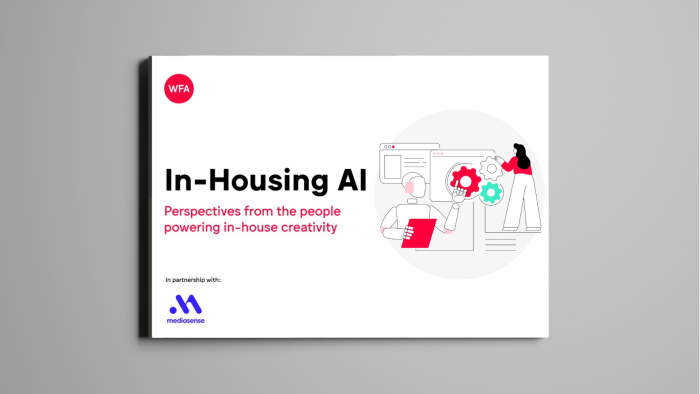
A new WFA report highlights how in-house agency teams are embracing the era of AI and potential opportunities in the generative AI space within marketing. Brenna Brandes, Global Marketing Services Manager at WFA, explains.
The AI revolution has shown us that its effects extend across the entire marketing ecosystem. It’s influence is reaching every stage of the marketing process and WFA wanted to understand how in-house agencies have adapted.
Working in collaboration with mediasense, our strategic partner for transformation, we conducted both qualitative and quantitative research to dive further into this topic. Through survey results and in-depth interviews with 30 global in-house agency leaders, we sought to understand how AI is changing the way they work.
According to our findings, most in-house agency teams are either experimenting with (65%) or partially implementing (71%) AI within their processes. The intent for further growth in AI is apparent: more than nine in 10 (93%) reported they plan to invest further in AI in the next 12-24 months to some level.
Benefits are already being seen within these experimental or beginning implementation stages, with 40% of in-house leads reporting they have seen faster content production (40%) and increased efficiency (33%) with AI adoption.
Though sixty-five percent of participants currently have a creative in-house agency, their resourcing models vary widely – from fully internal to almost entirely external. Such diversity in team size, scale, and available resources means adoption likely won’t look the same and each will need to implement a bespoke approach that best suits their business needs.
Like many other parts of the marketing ecosystem, there are challenges. Many of these will be familiar to anyone involved in AI implementation: they include ethical concerns such as authenticity and AI bias (64%), data privacy concerns (57%), and integration with existing tools and brand IP/copyright (50%).
Leading in-house marketers are trying to address such concerns by proactively embedding AI governance into their operations, establishing dedicated AI governance teams and mechanisms from the outset. Such teams are often responsible for supervising and approving tools and use cases from the lens of ethical values, regulatory requirements, and legal standpoints.
As with any transformative technology, the path to adoption is uneven, with questions around implementation, integration, and impact still to be resolved. Insights from our new report, In-Housing AI, reveal how these agencies can progress on their AI journey.
For many, the roadmap includes pilot programmes as a way to create a safe, controlled environment to experiment and explore potential benefits of AI use without committing to full-scale adoption.
That cautious approach is understandable: we also discovered that ROI on generative AI appears inconsistent. Nevertheless, the report highlights opportunities for future AI application in areas such as personalisation, strategic decision making, and data-driven insights.
The report also identifies potential areas for improvement, including:
With just 12% of respondents already at the stage of fully integrating AI (although 24% have enterprise-level integrations such as dashboards to support), there’s still a long way to go.
While AI feels immediately useful to practitioners, scaling across the organisation requires alignment on systems used, governance and strategy. Seamless workflow and enterprise integration are often lagging, creating bottlenecks for scale.
The truth is – as 36% of our survey respondents reported – integrating AI into corporate systems in an effective and efficient manner while addressing the many concerns about the technology is difficult.
Nevertheless, it’s clear that the work is progressing and opportunities for further innovation and efficiency remain.
Continue the conversation
WFA's In-House Forum helps senior global marketing professionals navigate the process of in-housing for their organisations. It covers topics ranging from agile ways of working, measuring performance and success of your in-house agency to attracting talent and the adoption of innovative technologies. Value is delivered through research and reports, physical and remote forums, and online tools and benchmarking services. If you'd like to learn more and get involved, reach out at b.brandes@wfanet.org.