
Get analysis, insight & opinions from the world's top marketers.
Sign up to our newsletter.
At this year’s Campaign360 in Singapore, WFA’s Asia Advisory Board unpacked one of marketing’s most over-romanticised constructs: brand purpose. Chrystal Yeong, Senior Manager, Global Marketing Services at WFA, reports.
For years, brand purpose has been framed as a driver of long-term growth- a way to build emotional connection, cultural relevance and differentiation. But when it comes to putting purpose into practice, the answers are often less straightforward.
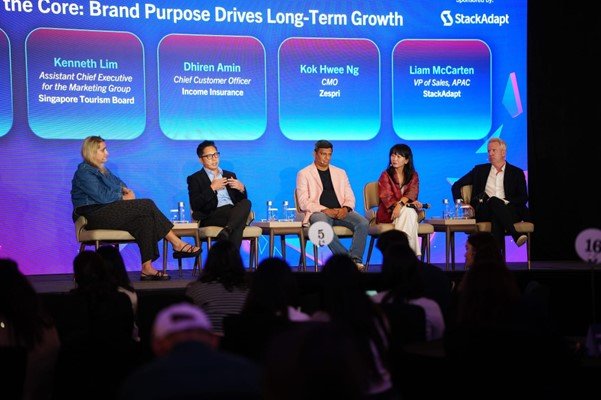
From left to right: Laura Forcetti (WFA), Kenneth Lim (Singapore Tourism Board), Dhiren Amin (Income Insurance), Kok Hwee Ng (Zespri), Liam McCarten (StackAdapt)
Across the panel, one theme emerged clearly: purpose may take different forms across organisations – but it is rarely a magic wand for growth.
For some, purpose is foundational to how the business operates. Dhiren Amin, Chief Customer Officer at Income Insurance, pointed to the organisation’s origins – created to provide financial protection for every Singaporean – as the reason purpose is so deeply embedded into how the business thinks, behaves and makes decisions.
“For us, purpose defines who we are and how we operate our business,” he said.
Elsewhere, purpose is closely tied to stakeholder value creation. At Zespri, Kok Hwee Ng, Chief Marketing Officer, described their purpose as “helping people, communities and environments thrive through the goodness of kiwifruit” – a philosophy that shapes how the organisation thinks about nutrition, grower value and long-term impact.
For the Singapore Tourism Board (STB), purpose plays a broader ecosystem role. Kenneth Lim, STB’s Assistant Chief Marketing Executive, explained that the organisation’s “Passion Made Possible” brand purpose serves less as a direct growth lever and more as a north star, helping align a highly complex tourism ecosystem around a shared ambition and identity.
“Purpose alone cannot drive outcomes- it must work alongside market realities, partnerships and industry economics,” Kenneth noted.
The real test, however, is what purpose looks like in practice.
At Zespri, purpose shapes the role the business plays in tackling hidden hunger through natural nutrition. This influences everything from partnerships to nutrition literacy programmes. Kok Hwee warned against purpose drifting into abstraction: "Purpose has to be credible and relevant for the brand, not just philosophical, world-changing CSR language,” she explained.
At Income Insurance, purpose drives product innovation. “Our purpose enables us to identify consumer gaps and create products customers are currently lacking,” said Dhiren. He pointed to innovations such as insurance-by-the-hour products for short cross-border trips and enhanced travel coverage for customers with pre-existing medical conditions.
“Purpose is a multiplier and amplifier for growth, provided we get the fundamentals right,” Kok Hwee said. “It doesn’t replace the fundamentals.”
In other words, product, distribution, pricing and performance marketing still do much of the heavy lifting. Purpose shapes how those levers are pulled, not whether they work.
A persistent myth, though, is that purpose only delivers over time. "There's a false binary between long-term and short-term growth," argued Dhiren. "Long-term growth is really a series of short-term achievements."
This distinction matters at a time when CMOs are under real pressure to justify long-term brand investment against short-term commercial demands. Liam McCarten, VP of Sales at StackAdapt, noted "Our recent co-authored study with Kantar showed that 80% of marketers are skewing away from brand towards lower-funnel performance", with a predictable consequence: brand distinction erodes and businesses end up competing on price.
Purpose-led innovation, when embedded into products and services people genuinely value, can generate immediate commercial returns and build longer-term equity at the same time. "Innovations allow us to drive sales on a quarterly basis and meet our numbers," said Dhiren.
"Purpose is not something marketing can do alone because purpose is not just a piece of advertising," said Kok Hwee. "Marketers must increasingly act as internal translators and orchestrators, helping functions across the business understand what the brand stands for and how that should influence decisions."
Kenneth echoed this challenge from a destination-marketing perspective. “Our purpose helps drive the vision and mission not just of the organisation but galvanises partners to follow us on that journey.”
For Dhiren, the answer is ultimately about accountability. “Be clear about what purpose is meant to drive in your organisation. If purpose is really working, your business should be growing, and the numbers should reflect that,” he said.
He added that whatever purpose translates into – trust, brand power, or a specific attribute – it must become part of broader corporate KPIs, not just marketing metrics.
The future of brand purpose may not lie in louder claims or more ambitious messaging. Instead, it may lie in something less glamorous but ultimately more effective: consistently making decisions that reinforce what the brand truly stands for and the outcomes they choose to measure, especially when it's inconvenient to do so.