Get analysis, insight & opinions from the world's top marketers.
Sign up to our newsletter.
Labour-based models are now used as the standard payment model by less than a fifth of multinationals, down from more than half in 2011
Factors affecting agency performance extend far beyond remuneration with briefing, respect and trust and feedback all scoring higher than financial rewards
Global brands are shifting towards a mix of output-based payment models and have effectively ditched the traditional labour model over the last 15 years.
A new report by WFA and Agency Mania Solutions reveals that the use of labour-based models has fallen dramatically over the last 15 years dropping from 54% in 2011 to 19% today, with a significant drop from 33% in 2022 when the research was last carried out. Over the last decade and a half, fixed-fee/output models have risen from 20% to 33% and labour-plus-performance models have more than doubled, from 9% to 21%.
Looking ahead, performance-based fees show the strongest momentum, with 63% expecting increased use, followed by value-based models at 46% and fixed-fee or output-based approaches at 36%. By contrast, 42% anticipate further reducing labour-plus-performance arrangements, while commission models also face more contraction than growth.
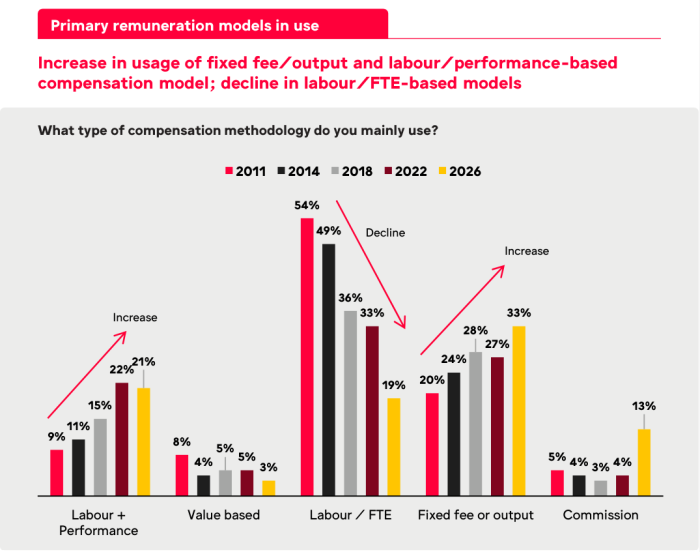
Agency remuneration models continue to evolve, with brands moving away from traditional labour-based approaches towards fixed-fee, value-based and performance-linked compensation models.
How Brands Define, Scope and Reward Agency Work also predicts that AI will accelerate this process, given that the technology allows agencies to do more, faster. Brands, however, are still catching up, with only 20% already evolving their commercial models in response to AI, although 61% intend to.
The findings are based on responses of 69 different multinational companies, representing six different industry sectors and a collective global marketing spend of $147 billion. Most (71%) respondents were in a global marketing procurement role.
“Clients ultimately care about the quality, impact and performance of the work – not how many people or hours were required to produce it. AI is accelerating this transition by enabling agencies to complete many activities faster, making time an increasingly weak proxy for value,” said Laura Forcetti, Director of Global Marketing, Sourcing and Director Marketing Services, Asia Pacific at WFA. “The growth of hybrid approaches also shows that no single model suits every discipline or assignment. The future of agency compensation is not paying for effort, it is rewarding valuable work, delivered effectively.”
For the first time, this study also explored the wider picture of agency client relationships beyond remuneration. How Brands Define, Scope and Reward Agency Work also explores the full commercial cycle, from briefing and scoping, through ways of working and performance, to value, as well as remuneration and ultimately payment.
The results show that agency performance is not simply reliant on remuneration. The three strongest contributors to agency performance are great briefing (5.6 out of 6, where 6 represents essential and 1 represents irrelevant), respect and trust (5.2), and high-quality feedback (5.1). By contrast, financial incentives score just 3.9 out of 6, significantly behind quality, trust and feedback.
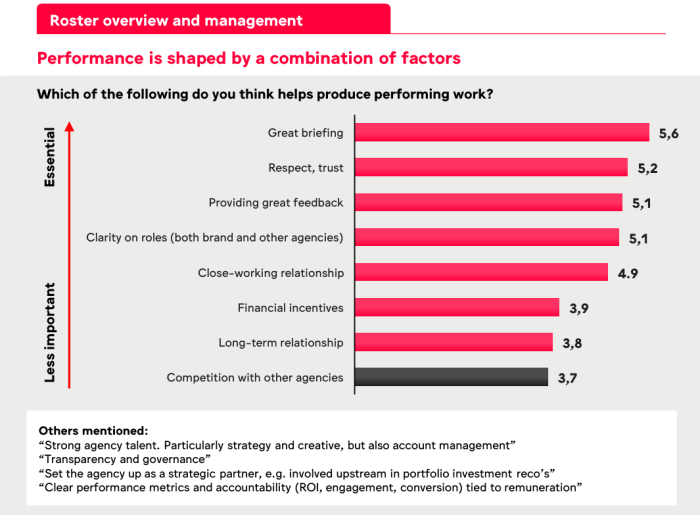
Brands rank briefing, trust and feedback as significantly stronger drivers of agency performance than financial incentives.
Agency relationships are now lasting longer than they did in 2018, with average tenure increasing across creative, production, media and paid social. Paid social has seen particularly striking growth, with average tenure moving from two years to 4.3 years since 2018.
“Becoming better partners isn't a mindset shift, it's an operational one. As AI reshapes how work gets done and priced, the brands and agencies who get ahead will be the ones building the clarity, shared definitions, and ongoing conversations that let trust and commercial models reinforce each other, instead of compensating for each other. That's the harder, more durable work than any single remuneration formula,” added Bruno Gralpois, Co-Founder & Principal, Agency Mania Solutions.
Other key findings include:
While brands expect greater use of outcome-linked models in future, they currently represent a relatively small share of agency fees. Across most disciplines, between 67% and 80% of respondents say performance-based remuneration accounts for less than 20% of total agency compensation. Adoption is highest in media-related disciplines, where outcomes are typically easier to track and measure than in creative and production work.
The pace of transition away from labour models varies by agency sector and while fixed-fee or output-based compensation dominates creative ad-hoc work (58%) and production (61%), where deliverables can often be clearly defined and priced, progress is less smooth in other areas. Media uses a more varied mix, with labour-plus-performance models accounting for 41% of media planning, 34% of media buying and 30% of paid social arrangements.
In the USA and Canada, labour/FTE remains the most common approach at 38%, followed by fixed-fee or output-based models at 29% and labour-plus-performance at 21%. Europe is more diversified, with fixed-fee or output-based compensation leading at 32%, while Asia Pacific is most strongly oriented toward fixed-fee or output-based arrangements at 44%.
Global contracts are used by 67% of respondents for media planning and 61% for media buying, compared with 49-52% for integrated creative and Creative AOR relationships. Creative ad-hoc work, however, remains far more local, with 50% managed through individual national contracts, while production reflects a more balanced mix of global, regional and local approaches.
35% say agency relationship management has become more difficult, compared with just 12% who say it has become easier. This highlights the demanding environment: more stakeholders, more complex scopes, faster timelines and greater expectations around data, technology, integration and transparency.
Most brands – 63%, up from 60% in 2022 – do not adjust media agency remuneration against volume rebates. Among those that do, the adjustment is generally modest: 25% say rebates offset less than 10% of agency fees, while only 7% report an adjustment between 10% and 30%.
89% of brands believe they get value for money from their agencies but only 48% feel they have sufficient transparency into agency costing and profitability. The opportunity is therefore not simply to negotiate harder, but to build greater mutual understanding of how value is created.
For more information or questions, please contact us


NIVEA's Global VP, Tobias Collée, shares on the importance of humanity and cultural respect, as part of the Candid CMO series.