Get analysis, insight & opinions from the world's top marketers.
Sign up to our newsletter.
State of AI in Marketing 2026 shows AI moving beyond content into insights, media and strategy, with scaling and skills now the biggest challenges
AI has moved from hype and experimentation to an integral part of the mechanics of marketing in 2026 with 96% of brand using generative or agentic AI, up from 45% in 2023.
And it’s being put to a much wider range of uses. In 2023, dominant applications were content creation, production and ideation. Today, 80% use AI for content creation, but 74% for content ideation and production, 72% for research/insights, 54% for media buying/optimisation, 48% for strategy and planning and 46% for workflow automation/autonomous agents.
The WFA’s State of AI in Marketing 2026 report reveals a shift in approach from marketers, with a substantial proportion looking to AI as a source of growth rather than just efficiency savings. Today, 33% say efficiency, effectiveness and growth objectives are all equally important. Twenty-two percent prioritise effectiveness and 22% efficiency, while 18% growth. Two years ago, 70% of brands said their primary objective was marketing efficiency, and only 30% said effectiveness.
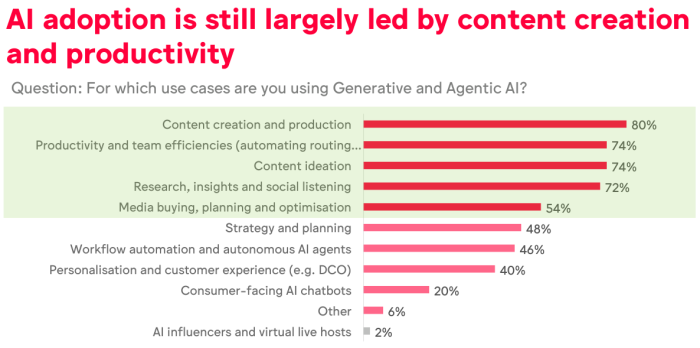
AI adoption has expanded far beyond content creation, with brands increasingly applying AI to insights, media, strategy and workflow automation.
In line with this greater ambition, AI governance now focuses on practical controls. Seventy-five percent of brands require human oversight of AI-generated outputs, 70% maintain approved or prohibited tool lists, and 57% require review and approval of AI-generated outputs. A further 55% have a centrally approved list of AI tools with clear governance processes for introducing new ones (up from 18% in 2023).
The study is based on 54 senior respondents from 46 of the world's top brand owners with a collective ad spend of $93bn.
"Whatever reservations brands may have about AI, they are focused on taking advantage of the technology right across their marketing organisation. The breadth of uses represents an industry that is getting to grips with the opportunity, but the next stage will be to deploy proven use cases at scale around the world," said Stephan Loerke, CEO at WFA.
The big challenge facing many WFA members is not finding AI platforms to advertise on but scaling adoption. This is now a top three priority for 63% of brands, but technology integration and interoperability (45%), governance/legal requirements (43%), data quality and access (37%) and skills (35%) remain the biggest barriers.
Boosting staff skills is a major task and while training and upskilling has become a top three organisational priority for more than half (55%), 69% still describe AI literacy as moderate.
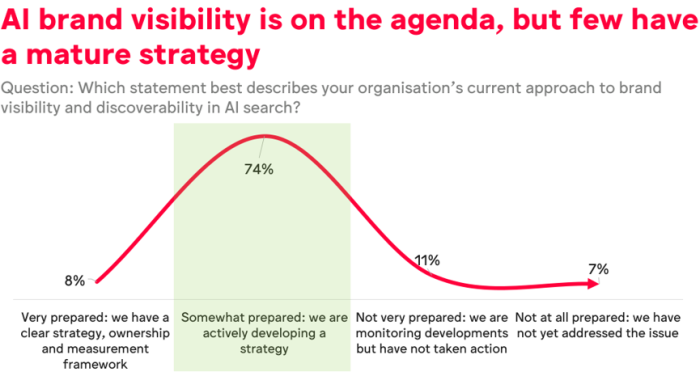
Most brands recognise the importance of AI discoverability, but few have developed a clear strategy for managing visibility in AI-generated responses.
Other key findings include:
In 2023, only 3% of brands had full visibility into how their supply chain was using generative AI. Today, only 13% have a great deal of visibility into agency AI use. Brands are responding by formalising governance through contracts, with 59% introducing AI-related contractual clauses covering issues such as IP, confidentiality and training data, while 69% require agencies to disclose when AI is used.
In 2025, 96% of brands expected AI-generated search to significantly transform brand discoverability and 65% were reviewing their SEO approach. Today, 73% are taking active steps to monitor and measure AI visibility and 67% are adapting SEO, 58% are reviewing content strategies and 51% are defining roles and responsibilities, but only 8% have a clear strategy in place.
This is why WFA collaborated with DEPT to provide actionable steps brands can take to better understand and prepare for how AI search is changing consumer discovery. Download our report on the future of brand discoverability here.
Paid advertising in LLMs remains nascent: only 4% rank it among their top priorities, although 20% are testing. Concerns are significant, with 85% moderately or very concerned about brand visibility/control and transparency, and more than 60% concerned about consumer trust, regulation, reputation/safety and measurement.
“AI has moved from nice to have into a competitive advantage. Brands are working hard to ensure the technology can safely become part of their operating system with clear human oversight, but they still need to upskill their teams to maximise the potential gains and that competitive advantage at scale,” concluded Loerke.
WFA’s AI Community, now bringing together more than 1,000 senior marketing professionals from over 150 multinational brands aims to provide the practical insights and knowledge they need to scale AI adoption while managing risks.