Get analysis, insight & opinions from the world's top marketers.
Sign up to our newsletter.
World’s biggest companies say there’s an acute shortage of people who can deliver judgement, prioritisation and insight development. Brands need to upskill existing staff rather than trying to hire their way out of the problem
AI is redefining the way brands work with talent and develop their skill base, requiring a new approach that balances human skills with technical expertise, according to a new report from the WFA and its strategic partner mediasense.
The report identifies strategic thinking as marketing's biggest talent gap, with 72% naming it as the No. 1 talent shortage. Across the board brands, agencies and platforms cite the need for talent with judgement, an ability to prioritise, insight development skills as well as business understanding rather than purely technical expertise.
Fifty-nine percent say strategic judgement and prioritisation skills will become more important in the age of AI and a further 52% say the market for leading talent has become “harder” or “somewhat harder” over the last two years as demand for AI, data and strategy talent accelerates.
“This study is a sobering reminder to brands, agencies and platforms that humans must remain firmly ‘in the loop’ on AI to fully realise its full impact. The continued challenges around marketing talent point to the over-correction organisations have made on technical skills over the critical and strategic judgement the industry needs to create the differentiation and growth brands are urgently seeking,” said Ryan Kangisser, Chief Strategy Officer at mediasense.
The second biggest talent shortage was in data strategy and execution (46%) followed by insight development (36%) and marketing fundamentals (34%).
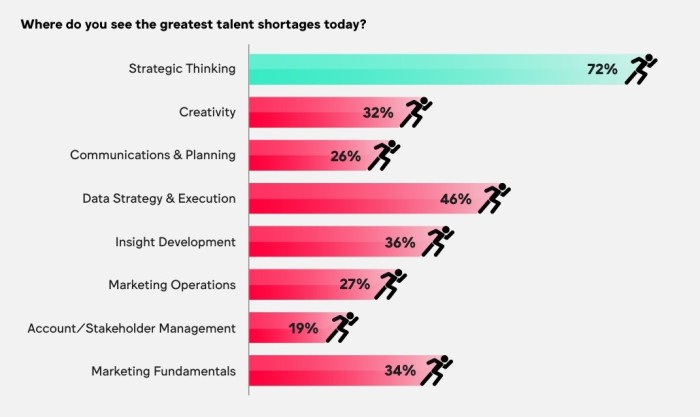
In the age of AI, strategic thinking is still marketing’s biggest talent shortage, cited by 72% of respondents, ahead of data strategy and execution (46%) and insight development (36%)
Humans, Marketing and Machines: How talent, skills and incentives are being redefined is based on responses from 166 industry professionals across brands, agencies, platforms and other organisations, including representatives of 65 brands spending $80 billion on global marketing each year.
It argues that the competitive advantage comes not from the best AI tools, but from with the strongest ability to combine technology with human judgement. The current drive to secure more strategic thinking reflects the need to identify the human value and skills needed to maximise the gains from new AI-powered tools, as automation increases, competitive advantage shifts toward capabilities that are difficult to codify or automate.
“As technology and tools become more important, ensuring marketers have the right capabilities is a major agenda item for CMOs cited as a top priority in our member surveys. Faster adoption and integration of new skills have become a competitive advantage for now and in the future. Naturally, the answers will be different for each brand but the key finding that stands out is the fact that upskilling existing teams is a foundation process for success,” said Julia Kraft, Associate Director, Global Marketing Services at WFA.
The report suggests that in the medium term, the biggest risk facing many marketing organisations is not access to technology, it is their ability to upskill existing talent fast enough to take advantage.
More than half (52%) of respondents rank the inability to upskill existing talent fast enough among their top two talent risks for the next three years. Just 1% believe better tools and platforms will be the primary differentiator of organisations with strong marketing talent in the future.
Top missing skills that brands need include AI fluency – the ability to understand, apply, direct and critically evaluate AI as part of everyday work – and data-driven decision-making are simultaneously identified as the most underdeveloped capabilities today. Fifty-six percent of respondents identify AI Fluency as underdeveloped and 55% identify Data-Driven Decision Making as needed additional skills.
One key change that’s needed to fill the talent pipeline is to redesign incentives. Right now, there’s a fundamental disconnect between the skills the industry says it needs and the behaviours it actively rewards. Agencies, for example, are incentivised to execute the brief – not challenge it, even though strategic thinking is the biggest talent gap within marketing organisations. Many respondents do not believe incentive structures adequately recognise them. Respondents ranked current incentive models as just 2.6 out of 5, where 5 is the best possible solution.
The report argues that future winners will combine AI with strong leadership and culture, as the strongest future differentiators, ranking far ahead of tools alone. Success will depend less on access to technology and more on how organisations integrate it into ways of working, decision-making and talent development.
For more information or questions, please contact us