Get analysis, insight & opinions from the world's top marketers.
Sign up to our newsletter.
While many in our industry were in Cannes last month celebrating creativity, members of WFA’s Asia Advisory Board supported the movement from Singapore, organising an evening event for those who couldn’t make it to the French Riviera.
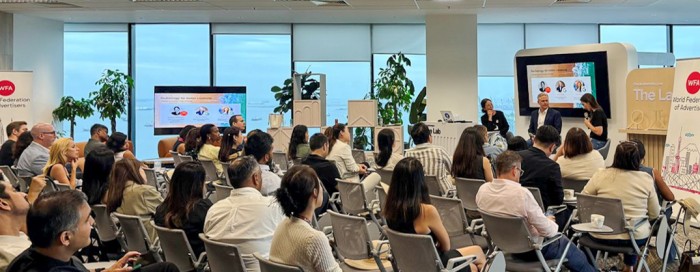
Hosted by Google Asia-Pacific in Singapore, the event welcomed 50 senior marketers from 29 multinational companies, along with a selection of Googlers, on 19 June 2025.
The evening explored how creativity drives growth, with three sessions: the first on how technology empowers creativity, the second on the role of insights in the creative process and the third on linking creativity to commercial impact. Key take outs from this evening of inspiration included:
Technology offers incredible potential to work faster and smarter. But the real challenge – and opportunity – is identifying which parts of this ‘augmented’ partnership between machine and human creativity will deliver competitive advantage.
Simon Kahn, CMO, Google APAC, suggested that AI will eventually become as commonplace as electricity. “AI is making content creation and localization incredibly efficient, and it’s exciting to see all the experimentation underway,” he said. “But let’s be honest, more output doesn’t always mean better work. If we’re not careful, we risk flooding the market with mediocre or even bad content. The future belongs to those who see AI not just as a tool, but as a catalyst for a continuous experimental mindset.”
Siddhi Desai, APAC Digital Content Lead at Diageo, added that new team structures may be needed to make the most of this shift: “We’re building teams powered by AI and figuring out how our people and AI can live, work and create together. But here’s the thing: AI can’t just sit in a room with marketers. It needs creative direction: someone to guide it, shape it, push it."
AI and technology shouldn’t be seen as threats to human creativity, but as accelerators. They’re not here to replace creativity, but to help us respond to culture in real time.
Angelina Villanueva, CMO, Asia Business Unit at McDonald’s, described AI as a creative sandbox, a powerful resource that opens new possibilities. “Culture is moving faster than ever and AI can help by quickly aggregating signals and giving us a clearer view of what’s happening in real time. That’s what enables us to move fast, to stay sharp, relevant, and resonant,” she said. But she also cautioned that “the real muscle we need to build is resourcefulness: the ability to leverage AI to elevate creativity, not dilute it. It’s about using technology to enhance, not average out, the ideas we bring to life.”
With data analytics and pattern recognition, technology can now uncover trends in seconds that once took weeks. But for creativity to truly resonate, it takes more than speed. Hedda Sabaot, Regional Consumer and Market Intelligence Director at Shiseido, shared: “It’s about combining high creativity – something digital tools can boost – with high empathy, which only comes from human touch,” she said.
Creativity thrives on collaboration as well as knowing when to pause. True success comes from striking the right balance: knowing when to move fast and when to slow down.
As Angelina Villanueva noted: “It’s about creating space for experimentation and inspiration, and recognising that collaboration across partners brings out better work. We need to stay open: open to the expertise around us, to new ways of working, and to the idea that creativity thrives when it’s shared.”
Lex Bradshaw-Zanger, CDMO, SAPMENA at L’Oréal, echoed the importance of meaningful interactions. For him, this shift transforms the role of the CMO into an orchestrator across people, tools, brands and geographies. “Because in the end, creativity isn’t just about the art or the copy,” he said, “it’s about the culture built, the conversations nurtured, and the connections made.”
A key challenge for marketers is connecting a creativity-driven function to hard commercial KPIs, proving to CEOs, boards and stakeholders that marketing is truly worth the investment.
Lex Bradshaw-Zanger highlighted that measurement remains a major hurdle in demonstrating creativity’s commercial value. “We’re still measuring what’s easy, not what matters. The hard stuff, like the true impact of creativity on brand growth, often gets overlooked because it’s difficult to quantify. At the same time, marketing seems to have lost clarity around its strategic goals. Are we building brand equity? Driving short-term sales? Upselling within a category? Too often, it’s unclear.”
Sameer Desai, VP Marketing and Commercial Operations, APAC at Align, reinforced that brand and business performance are inseparable. “It’s not a choice between short-term and long-term, both matter and they’re deeply connected. The short term is easier to measure, and that’s important. But the long term? That’s where brand is built. And we need to get better at proving its value to drive growth.”
It’s no longer a choice between short-term and long-term.
Dhiren Amin, CCO at Income Insurance, stressed the importance of balancing both. “Often, you need to secure the basics first, fund the tactics that drive short-term sales and meet immediate business needs. Doing that gives you the freedom to swing for the fences with the rest, to invest in bold, creative ideas that could shift the brand over time. Areas like consumer promotions can be a great canvas for creativity because they’re directly tied to revenue. If you do something distinctive there and it works, it earns you permission to take bigger creative bets elsewhere.”
Cheryl Goh, Group Head, Marketing & Sustainability Officer at Grab, agreed that marketers need to grow more comfortable with balancing both horizons. “The reality is, we must deliver on short-term goals, that’s what CEOs are watching, but we also have to champion the long-term. That’s our responsibility as marketers: to build today and tomorrow, at the same time” she said. “It’s much harder to secure investment in long-term initiatives because results take time to show. My role is to help the organisation see that long- and short-term efforts must work hand in hand to drive real business outcomes.”