Get analysis, insight & opinions from the world's top marketers.
Sign up to our newsletter.
How people relate to media, ambition, technology and each other is changing. Katrina Dodd, Trends Editor at Contagious, shares on the tensions that are reshaping consumer behaviour in 2026.
Abundance isn’t always a good thing.
We’ve never had more content, more convenience, more wellness advice, more ‘connection’. But somehow we’ve never felt less fulfilled.
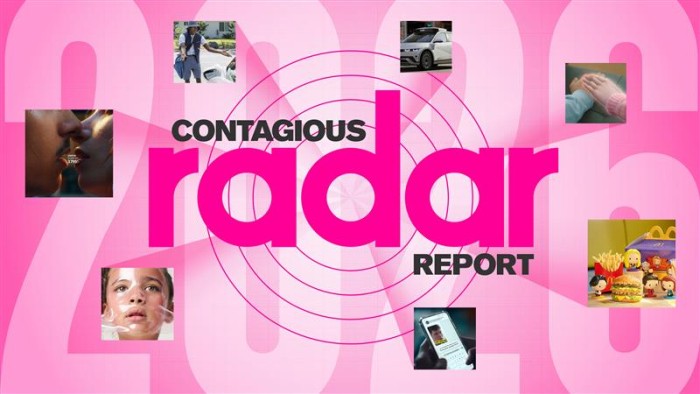
The Contagious Radar 2026 takes a long hard look at this conundrum, identifying six tensions that are reshaping consumer behaviour – recalibrations in how people relate to media, ambition, technology and each other. It also breaks down what that means for brands trying to maintain their cultural relevance in a relentlessly unstable economic environment. You should totally read the whole thing.
But here’s the TL;DR version, just in case.
In the 1960s, behavioural scientist John B Calhoun built Universe 25 – a perfect world for mice. Unlimited food, no predators, space to thrive. The colony failed: the mice became aggressive, stopped breeding – Calhoun called it a ‘behavioural sink’.
In 2026 we’re living in the Universe 25 of content – and facing an Attention Sink created by the cognitive overload it’s creating. For marketers, in these conditions the challenge is not visibility, it’s memorability.
In an attention sink, the winners aren’t the ones who mindlessly add to the noise, they’re the ones people actually remember.
Nostalgia has become one of the dominant operating systems of contemporary culture. The past is no longer lost to us as time creates distance – it’s part of a perpetual feedback loop, permanently available on demand.
For consumers, nostalgia offers comfort and emotional safety – partly because familiarity offers reassurance in periods of instability.
For brands, there’s a watch-out: nostalgia is powerful, but only when used with intent. Recreating the look of the past is pretty basic – the real opportunity is recreating the feeling.
After years of frictionless digital connection, many consumers are craving something more tangible.
The resurgence of run clubs, supper clubs, craft communities and live experiences points toward a growing desire for IRL belonging and participation. Physical presence is starting to feel… premium.
That creates an interesting opportunity for brands. Increasingly, consumers are not simply looking for products or content, but for experiences that facilitate connection, reinforce identity and encourage joining-in.
Community, in other words, may need to mean more than a moderately active Discord server.
The cultural perception of social media platforms is shifting. Increasingly, the language surrounding them centres on addiction, behavioural manipulation, mental health concerns and – finally – regulation.
For marketers, this creates a potentially uncomfortable predicament. Many brands remain deeply dependent on platforms whose reputations are becoming steadily more complicated. At the same time, consumers are becoming more selective about where they spend their attention and whom they trust within increasingly noisy digital environments.
As a result, owned audiences, direct relationships and trusted communities may become more strategically valuable than those offering scale alone.
Modern consumer culture increasingly treats self-improvement as a 24/7 responsibility. People are encouraged to optimise their sleep, productivity, gut health, appearance, mindfulness and longevity – tracking and training their way to being better across every possible dimension.
Wellness has shifted from aspiration into obligation – but consumers are starting to feel the burn. That exhaustion is reshaping expectations around health, beauty and lifestyle marketing.
Brands that preach perfection and prey on feelings of inadequacy may face diminishing returns, while those offering simplicity, balance and emotional reassurance stand to gain in relevance.
For decades, advertising has relied heavily on future-oriented aspiration: work hard, improve yourself, buy the right things and tomorrow will be better than today.
Consumers have less belief in that bargain than ever.
Economic pressure, institutional distrust and cultural instability are reshaping attitudes toward success and progress, particularly among younger audiences. In response, many consumers are prioritising immediate quality of life, attainable pleasures and achievable comforts over distant traditional milestones.
Present-tense pleasure is starting to matter more than a brighter tomorrow.
Across every trend examined in the Radar run two almost unbearably human through-lines: first, the longing for a little more control, a little more agency in the face of relentless uncertainty. And second, the enduring appetite for meaning, comfort, connection and protection in the face of systems designed to capture, optimise and monetise people’s attention.
For any marketer grappling with where to focus their resources in the year ahead, we’d suggest starting there.
Katrina Dodd is Trends Editor at Contagious. She recently spoke at WFA Global Marketer Week 2026, where she made the case for why marketers should prioritise creative excellence in order to supercharge their brands and demonstrate ROI on their marketing spend. You can watch her pitch for creativity here: