
Get analysis, insight & opinions from the world's top marketers.
Sign up to our newsletter.
As the EU AI Act takes effect, brands need clarity when AI-generated advertising content must be disclosed. Maxime Ricard, Senior Digital Policy Manager at WFA, offers some thoughts.
WFA's latest webinar explored the practical application of Article 50, offering marketers an actionable guide on compliance, governance and consumer trust.
Article 50 of the EU AI Act is likely to become increasingly important for marketers because it establishes new rules on when brands need to disclose AI involvement in their content.
With the new rules now applying as of 2 August 2026, brands are grappling with practical questions around when AI-generated content must be labelled, who is responsible for applying those labels, and how the rules apply across increasingly complex advertising supply chains.
Earlier this month, we held a webinar on the new AI transparency rules with experts from Lewis Silkin and leading advertisers, where more than 110 participants from over 60 brands joined. During the session, we shared results from a previous webinar held in July, which showed that over half of respondents had started preparing for emerging AI transparency obligations but still had work to do, while only a minority (25%) said their organisation already had a clear policy and framework in place.
With over 75% of brands now using AI-generated or AI-enhanced content in their marketing creative, this highlights a significant action gap and potentially a serious governance risk.
WFA members also identified the EU AI Act as the single most important factor likely to shape their future approach to AI transparency, ahead of platform policies, self-regulation and consumer expectations.
This is an issue that WFA is supporting brands with globally. Over the past few months, WFA has developed global guidance on AI transparency and labelling, conducted member research to gather perspectives on brands’ current approach and launched a regulatory heatmap to help marketers track fast-changing requirements across key markets. Together, these resources are designed to help brands navigate an increasingly fragmented regulatory landscape, identify where brand consensus is emerging and develop practical and pragmatic approaches to AI transparency.
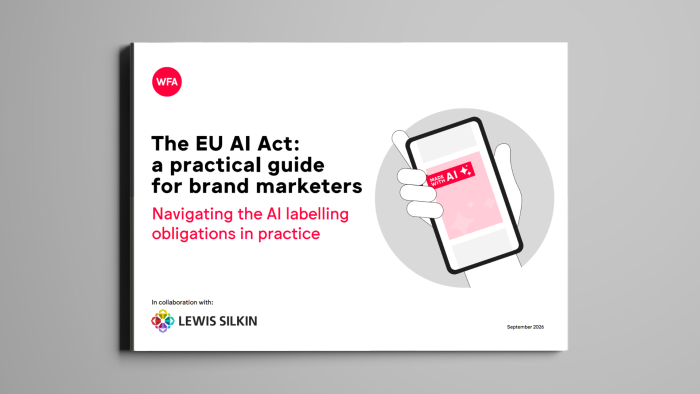
To help advertisers navigate these challenges, WFA has partnered with Lewis Silkin to develop a new guide on the practical application of Article 50(4) of the EU AI Act to marketing and advertising content. While not legal advice, the guide is designed to give in-house legal teams, compliance professionals and marketers responsible for approving and deploying AI-generated or AI-enhanced advertising with expert insights to help them interpret the new rules in practice in the EU.
It also reflects a broader reality: AI is already deeply embedded in modern advertising. It is increasingly used to generate product imagery, create backgrounds, support creative production and improve efficiency across marketing workflows. As adoption expands, brands need practical tools that allow them to innovate responsibly while maintaining consumer trust and complying with emerging regulatory expectations.
“AI is rapidly becoming part of the everyday toolkit of modern marketers. While the opportunities are considerable, brands also need practical guidance to navigate a regulatory framework that remains new and, in some areas, uncertain. This guidance is designed to help marketers understand their obligations under the EU AI Act while continuing to innovate responsibly and build consumer trust.” said Stephan Loerke, CEO of WFA.
Determining whether content qualifies as a "deepfake" requiring disclosure will often depend on a contextual, case-by-case assessment. Equally important are questions around responsibility across the advertising supply chain, particularly where brands, agencies and production companies all play a role in the creation and approval of campaign assets.
The guide helps advertisers interpret the European Commission's legal and technical framework Commission's legal and technical framework in a marketing and advertising context. It explains the deep fake definition, analyses the Commission's advertising-specific examples, discusses deployer responsibility and provides a practical framework for governance, contracting, creative approval and record keeping. It is intended to support internal discussions and compliance planning rather than provide legal advice.
“The Commission's Guidelines are a welcome step forward, but many practical questions remain for advertisers. The challenge is not simply understanding the legal definition of a deepfake, but applying that definition consistently across a wide range of advertising scenarios. Our goal was to provide brands with practical guidance that helps them make those decisions with greater confidence and consistency.” said JJ Shaw, Partner at Lewis Silkin.
The guide also addresses one of the most important questions currently facing the advertising industry: how to apply transparency obligations without creating unnecessary complexity or over-labelling low-risk uses of AI.
The final Commission guidelines make clear that not every use of AI in advertising requires disclosure, but they also place considerable emphasis on contextual assessment and judgement.
As a result, robust governance and clear internal decision-making processes are becoming increasingly important.

For more information or questions, please contact Gabrielle Robitaille at g.robitaille@wfanet.org
NIVEA's Global VP, Tobias Collée, shares on the importance of humanity and cultural respect, as part of the Candid CMO series.