Get analysis, insight & opinions from the world's top marketers.
Sign up to our newsletter.
Marketing is under pressure, budgets are tight, and the data we rely on to prove our value is increasingly being questioned. Lex Bradshaw-Zanger, Chief Business Capabilities & Innovation Officer, SAPMENA at L'Oréal, explores marketing’s crisis of confidence
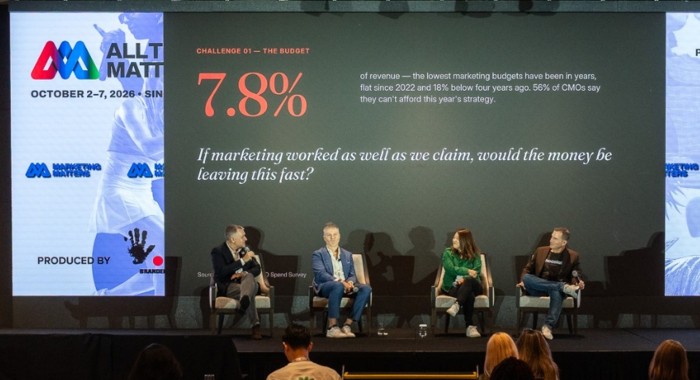
I had the pleasure of facilitating a lively (and at times, rowdy!) conversation on behalf of the WFA Asia Advisory Board at All That Matters in Singapore recently.
The goal was to ask some of the best marketers in the region about some challenging data and find a way to give our function its mojo back.
Joining me on stage were Ed Bell, General Manager, Brand, Insights & Marketing Communications at Cathay, Cheryl Goh, Chief Marketing and Customer Officer at Grab and Walter de Oude, Founder and CEO at Chocolate Finance.
1Half of business leaders – and 30% of senior marketers – rate their brand-building knowledge as average to very poor. Most still rank social media among the best brand-building channels, despite evidence placing it last.
For Ed, marketing earns its strategic role by helping shape value, not just communicating it:
“Sometimes we confuse marketing communications with marketing. Marketing has always been about positioning, partnerships and pricing. At its best, marketing helps shape the product. At its worst, it simply amplifies what is already there.”
Walter went further, challenging the traditional boundaries:
“I don’t have a CMO, I have a Chief Growth Officer. The lines between marketing, sales, customer experience, and product are blurred. What you’re getting is a new breed of professional who isn’t a traditional CMO – a jack of all trades, and master of all!”
Cheryl reflected that there may be no single definition. She came into Grab as a business person, rather than a marketer: early on, the focus was usage and product. As the business matured, it shifted towards helping people remember what the brand stands for.
Marketing’s accountability now extends well beyond driving sales. But if marketers are expected to influence so many parts of the business, do they have the skills, influence and organisational support to deliver on that broader remit?
2Nearly four in five (78%) marketing decision-makers believe at least 10% of spend is wasted through poor measurement. If we don’t trust the numbers, what does it mean to “prove” that marketing works?
Cheryl cautioned:
“Build your own layer of measurement through incremental testing, and don’t simply accept your partners grading themselves. But there’s a danger in becoming so desperate to prove something that you stop doing things simply because you can’t measure them perfectly.”
Ed questioned whether perfect measurement should ever be the expectation:
“Marketing deals with psychology and the future. Just because there’s some inaccuracy in the data doesn’t mean the whole discipline isn’t worthy.”
Walter agreed, offering a pragmatic approach:
“Numbers indicate direction of travel and provide experimental evidence. Trying to attribute every customer to a specific investment across multiple touchpoints can send you down a rabbit hole.”
The common thread? Measurement should inform decisions, not become a substitute for making them. Better evidence and testing matter – but so does judgement. The real danger isn’t imperfect measurement. It’s letting the need for certainty distract us from what matters.
3Consumers rank trying the product far above advertising, cited by just 8%, while 94% of Gen Z trust influencers over traditional advertising. If the brand isn’t the most trusted voice, where does authority now come from?
Walter took the most sceptical view:
“People believe their friends and network more than they believe brands.”
Ed argued that:
“Brands remain a mental shortcut for what people expect from a product or service. They grease the path for the consumer to choose you”.
He also cautioned against overstating the shift towards creators: Cathay’s modelling shows relatively low influencer contribution to sales.
Cheryl brought the discussion back to the customer experience:
“Marketing is telling people what your product is about, what the promise is. For Grab, where you use this product many times in a week, that user experience is part of the brand. It is what people feel and believe, regardless of how much marketing money I put behind it.”
Perhaps the real question isn’t whether brands still matter, but how they earn relevance and trust in a world where they no longer have the floor to themselves.
It isn’t that marketing has stopped working. It’s that, somewhere along the way, we’ve lost sight of what makes it work.
We’ve risked reducing marketing to communications, virality and what can be measured quickly, while underplaying its broader role.
That doesn’t mean marketing should resist change. With creators, platforms and AI increasingly sitting between brands and customers, marketers need to be more critical about where influence really lies.
Marketing hasn’t changed, but marketers must. Not by abandoning the fundamentals, but by becoming clearer about which ones still matter.
1Financial Times / IPA, "The Board-Brand Rift"