

Get analysis, insight & opinions from the world's top marketers.
Sign up to our newsletter.
As global marketers adapt to AI, its environmental impact is set to become an issue of increasing importance, say Gabrielle Robitaille, Director of Policy, and Michelle McEvoy, Global Lead, Sustainable Marketing at WFA.
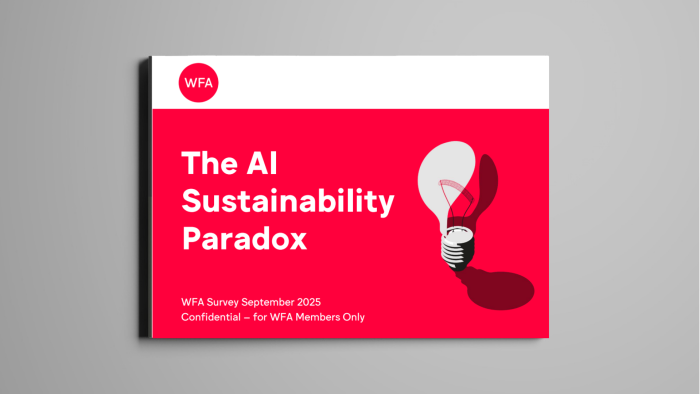
We all know that GenAI is transforming the way we live and work. As the pace of adoption quickens, marketers are looking for ways to ensure that the deployment of AI in marketing is both strategic and responsible. Accounting for the environmental impact of GenAI is a question of rising importance.
WFA recently surveyed members to find out where GenAI was being used and how sustainability was being integrated into the conversation. Thirty-two members, responsible for $72bn in global marketing spend, took part and all of them said they were using GenAI in marketing, albeit at different stages of the adoption journey. The primary application was in content creation, which is resulting in significant efficiency and effectiveness gains for many.
Some were also applying the technology to help address environmental issues related to marketing: 58% said AI has already supported concept development, innovation and R&D, 32% said AI was enabling marketing supply chain optimisation and 42% believed AI can support them in meeting their company's overall sustainability goals.
But while the opportunities of AI are clear, nearly half (44%) of respondents were concerned about the environmental impact of new tools and approaches. At this early stage, 64% think the use of AI may increase the environmental impacts of their marketing activities, while 82% felt that the full environmental cost of AI was currently unknown.
Whilst only 5% of respondents are already measuring the impact of AI tools/vendors and factoring that data into decisions about adopting or scaling AI tools, 8% went on to add that they have taken steps to mitigate or reduce the environmental footprint of AI use in marketing.
These early movers are taking key actions to take greater control, including developing measurement frameworks for monitoring the environmental impact of AI use, prioritising more efficient AI models or focusing on high-impact use cases.
But survey data suggests that the industry is on the cusp of significant change, with the majority of respondents (55%) already developing or exploring ways to measure the environmental footprint of AI tools or vendors. And 59% sharing that sustainability considerations will likely influence their team's decisions about adopting or scaling AI tools in future.
The solution for marketers is to take a closer look at the complex issues around the environmental impacts of AI. This includes:
While AI moves fast, we are at the stage where marketing leaders can take responsible steps today to help ensure the strategic, responsible and sustainable deployment of AI in marketing. And on balance, the outlook is positive, with nearly half (47%) agreeing that AI has the potential to reduce the environmental impact of marketing.
By asking the right questions in these early phases of adoption and proactively identifying, measuring and managing all impacts of AI in marketing, brand leaders can account for potential future risk whilst harnessing the potential of AI to drive sustainable growth.
The challenges of balancing the use of AI for its multiple business advantages and mitigating sustainability-related risks and impacts will be the theme in an upcoming remote meeting of the WFA’s Sustainable Marketing and AI Community on November 5th.
In this meeting, WFA members will hear from global brands on how they’re leveraging AI to drive business growth, how AI is expediting progress on sustainability goals and how brands are measuring and mitigating the environmental impacts of AI adoption in marketing.

For more information or questions, please contact Gabrielle Robitaille at g.robitaille@wfanet.org